
A practical guide to navigating the U.S. energy market for small and medium‑sized businesses

Energy is no longer a simple utility expense. It has become one of the most unpredictable and complex cost lines for small and medium‑sized businesses. Rising volatility, grid constraints, growing demand from data centers and electrification, and an evolving energy mix are making electricity and natural gas more complex—and more risky—especially for small and medium‑sized businesses (SMBs).
Nevertheless, energy decisions still happen reactively: A contract renewal arrives, prices look higher than expected, and a decision gets made under pressure. But as energy markets become more dynamic, this approach can leave businesses exposed to unnecessary costs, risks, and missed opportunities.
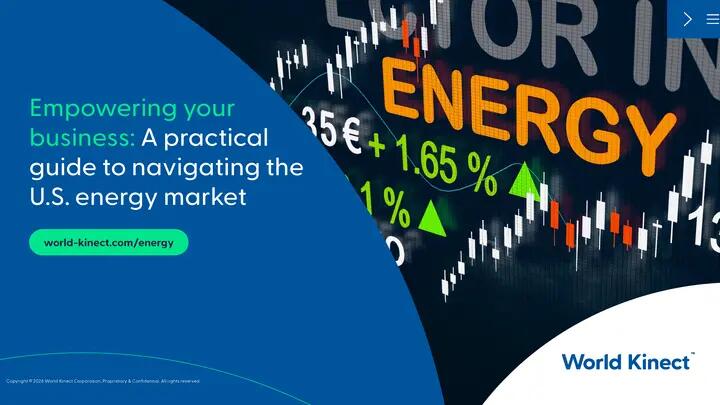
World Kinect’s latest eBook: Empowering your business: A practical guide to navigating the U.S. energy market, was created to help SMBs shift from reactive decision‑making to a clearer, more strategic approach to energy management.
What you’ll learn
✔ How the U.S. energy market really works
Understand the energy mix, deregulation, and the forces shaping electricity and natural gas prices.
✔ What actually drives your energy costs
From natural gas prices and weather to infrastructure and policy changes.
✔ How to build a simple, effective energy strategy
A practical roadmap designed for SMBs and detailed guidance for market timing.
✔ When and how to switch energy suppliers
Learn how the energy RFP process works, what to compare, and common contract pitfalls to avoid.
✔ How demand response can reduce costs and generate revenue
Turn operational flexibility into a source of value with programs designed for businesses like yours.
Access the full guide to turn these insights into measurable impact—or review the highlights below for a preview of what’s inside.
Download the book
A practical guide to navigating the U.S. energy market.
Why the U.S. energy market feels more complicated than ever
The U.S. energy system is no longer defined by a single dominant fuel or a one‑size‑fits‑all utility model. Instead, it’s shaped by:
- A changing energy mix, with renewables growing alongside natural gas and nuclear.
- Regional differences in regulation and market structure.
- Greater price sensitivity to weather, infrastructure, and global gas markets.
- Increasing pressure on the grid from electrification and industrial growth.
For SMBs, this complexity often shows up in the form of volatile pricing, confusing contract structures, and limited visibility into what’s actually driving energy costs.
The first section of the eBook breaks this down, with a detailed explanation of U.S. energy sources, their impact on pricing, the role of natural gas in both electricity and heating costs, and how business can leverage their position in a deregulated market.
Understanding these fundamentals is the first step toward controlling them.
How this guide helps you take control of energy costs
In the second part of the eBook, you’ll learn how to move from reactive contract renewals to a simple, effective energy strategy. The guide walks through how SMBs can:
- Make better‑timed procurement decisions.
- Choose contract structures that fit their risk tolerance.
- Use supplier choice and competitive RFPs to improve pricing and terms.
For businesses with operational flexibility, the guide explores how demand response programs can reduce peak costs.
Most importantly, this eBook provides a clear, step‑by‑step roadmap that helps SMBs:
- Reduce cost surprises.
- Improve budget predictability.
- Manage energy as a business risk – not just a bill to be paid.
- Align energy decisions with cost control, resilience, and sustainability goals.
Who this guide is for
- Small and medium‑sized business owners.
- Finance, operations, and facilities leaders.
- Businesses operating in deregulated energy markets.
-
Organizations looking to control costs, manage risk, or support sustainability goals.
Why download this guide?
- Practical explanations.
- Real‑world case studies and frameworks you can apply immediately.
- Focused on cost control, resilience, and smarter planning — not theory.
Whether you’re renewing a contract, evaluating suppliers, or trying to make sense of volatile bills, this guide helps you move from reactive energy decisions to a more strategic approach.
Discover more
Article | August 17, 2026
The important role of a Commercial Natural Gas Supplier in the US

Article | July 28, 2026
Planning for peak load: How organizations manage energy procurement

Article | July 15, 2026
Are you overpaying for energy? Nine questions every US energy leader should ask

Article | July 06, 2026
North America Energy Market Outlook: What you need to know

Article | June 29, 2026
Who can help with natural gas procurement in the U.S.?

Article | June 19, 2026
Commercial Natural Gas & Energy Procurement: A guide for municipal authorities

Article | June 17, 2026
Natural gas procurement in a volatile market: Why pricing risk stays elevated

Article | May 22, 2026
How the US energy market works: A guide for small and medium-sized businesses

Article | April 29, 2026
A guide to Risk Management in an era of energy cost volatility

Article | April 23, 2026
Energy procurement in a volatile market: How leaders can stay ahead of capacity-driven risk